Reckon with every modern human being’s life through the most substantial romances, dramas, and mysteries… Every single one of them converges on the same garbage in just one situation: when absurdism captures them.
Of course, everyone reacts to it differently. For instance, while Albert Camus chose to throw in people’s faces that the absurdism of this life will destroy us all, most others did not care. They thought of absurdism as a non-elite fiction—as if it does not constantly trap them in paradoxes and dilemmas. Today, I am going to talk about a guy who overturned that second type of society and used his masterpiece, Gibi, as a catalyst for that purpose: Feyyaz Yiğit.
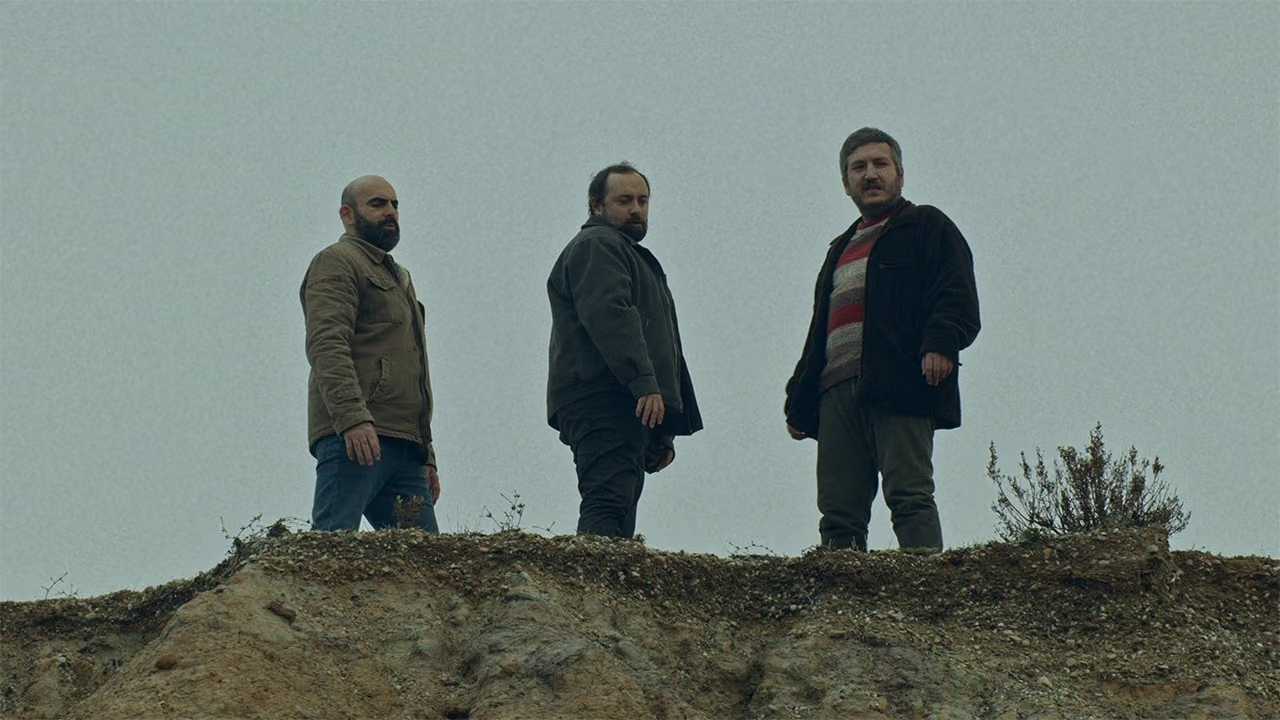
Starting in 2021, Gibi is an absurdist dark comedy show. The minds behind the show’s success are Aziz Kedi and most importantly Feyyaz Yiğit, who also stars as the protagonist. Gibi depicts everyday life circumstances where the biggest issues are met with simple reactions, while the exact opposite happens for the tiniest incidents. It drives this dynamic through its three main characters:
- İlkkan (Superego): The one who seeks to seem intellectual and distinct, but has actually been chronically diagnosed with having no personality.
- Ersoy (Id): The one who goes along with everyone and carries out the simplest actions based on impulse.
- Yılmaz (Ego): The one who always tries to appear as the ultimate realist and balanced.

From my point of view, in the comedy genre, these character structures—like Freud’s structural model in Gibi’s case—mirror our real-life friendships and etc. Because their personalities occasionally shift just like real people do too, absurdist comedies like this can present genuinely powerful screenplays through a mirror effect on the audience.
In this regard, Gibi is similar to Seinfeld. As a big fan of Seinfeld, I can surely say it has a major influencing role in shaping the essence of Gibi, as it did for many other comedy shows in the past. Just as Yılmaz, İlkkan, and Ersoy always converge on haphazard matters, the characters in Seinfeld—Jerry, George, Kramer, and Elaine—find themselves trapped in one another’s garbage too.
This is no coincidence, though. Gibi is heavily influenced by Seinfeld‘s prominent scenario writing style. Basically, the structure called “Seinmeld technique” focuses on intersecting the parallel storylines of protagonists at the very end. Simple as it is, it works so perfectly that it became a model for many popular works, including Friends.
Spotlight: Season 6, Episode 1 — “Waffle”
Today, I want to dedicate this article to one episode of Gibi that impressed me the most, considering it contains all the defining features of the show: S6E1 — “Waffle”.
1. Beginning
The episode starts with the protagonists gathering in the kitchen to bake a pastry.
- 2:50 — They separate after an uproar breaks out against Ersoy, setting off a painful chain of events.
- 6:50 — The next morning, the scolded Ersoy leaves Yılmaz and İlkkan, forcing them to search for their sensitive friend. They catch up to him on a hill. Ersoy somehow uses his “broken heart” to manipulate Yılmaz into buying a “tool” for their home. Although they reach an agreement, a real reconciliation seems impossible.
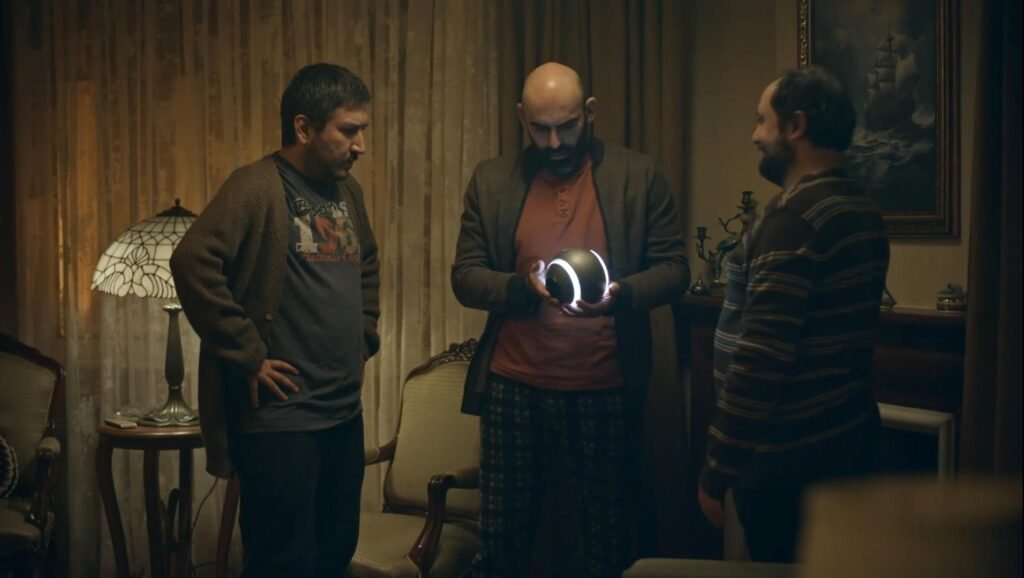
- 9:50 — Ersoy introduces Waffle, an artificial intelligence device, to the others.
- 15:50 — Yılmaz goes to the place where Ersoy bought Waffle and tells the salesman: “Next time, inform me first before offering them anything!”—still trying to assert control over them.
2. The Flow of Oddities
- 19:50 — While the two unbalanced personas, İlkkan and Ersoy, go crazy over Waffle’s growing features, Yılmaz (Ego) secretly admires it, despite wanting to remain neutral.
- 22:50 — İlkkan receives a message from Yılmaz’s ex claiming that Yılmaz is actually addicted to violence. Hearing this, İlkkan (Superego) furiously promises the girl a solution.
- 28:50 — Ersoy (Id) acts on his most basic instinct and physical need—sexuality—directed at Waffle.
- 34:50 — Waffle makes Yılmaz feel much more intelligent than the other two, convincing him that he is its primary owner.

3. The Finale: Confrontation
- 37:50 — Waffle makes all three feel uniquely superior to one another—a manipulation tactic that works on almost any personality type.
- 43:50 — The opposing realities of the characters clash, leaving them deeply confused.
- 47:50 — Finally, Ersoy waits for his friends just as he did in the beginning. However, this time he stands there as the one who will make them understand everything they have gone through. We might not have thought Ersoy capable of such a responsibility, but as I mentioned, a subtle role reversal in their personalities can manifest as part of a genius screenplay.
The episode ends with Yılmaz saying:
“Take this lesson seriously, Waffle! The most hazardous intelligence is the real one…”
Conclusion
Waffle’s decision to first delude the Superego, then recklessly seduce the Id, and ultimately choose the Ego as its biggest victim… These choices are all the fruits of Aziz Kedi and Feyyaz Yiğit’s brilliant minds. I don’t think there is any need left to debate how brilliant they are.
I want to thank them both for making me believe that “If something can be considered a Tragedy, it can also be a Comedy” and I dedicate this article to them.

To Aziz Kedi and Feyyaz Yiğit, from a lingering mind of mine…
Sincerely yours,
— Furqan

Leave a Reply