
As my favorite philosophical venue to hide in, existentialism usually offers me questions that it has actually already finished seeking—like why we always bump into “the act of survival,” basically “life,” out of the blue. Such questions squirm out of blurred melancholy and find an answer like, “Let’s say life must be understood as some bullshit from your perspective, Mr. Furqan, and move on.” Though, even when we can’t get to know the “genuine truth”—if there is one—and call it with all due respect “some bullshit,” there stand certain motivations behind the action takers: us. They are usually bonding motivations, like the presence of family and many other things…
However, to be honest, the most common motivation to go on without overthinking is the place to which you are bound: to be more bluntly clear, the country you are condemned to belong to. If you don’t believe such a theory, just think about why wars—where people who would normally be friends kill each other—are committed. Whether it is for the sake of peace or not, every human being wants to have an affair with something called “one’s country.” Today, I am going to write about a man who comes from a nation where you are called a “traveler” from the very first moment, as if being a traveler in a life you know nothing about isn’t enough. Ladies and gentlemen, here is dear Tony Gatlif, who has depicted his nation more beautifully than anyone else…

Residing separately like no other nation across six continents without a main homeland due to some unknown reason of departure 1,000 years ago, the Romani people—Gypsies (I am not fully aware of its offensive connotations, so I may write it at some points in this article; to your knowledge, there is certainly no way I am specifically choosing this word to offend anyone)—have probably been around all of us at some time. And because we have more usually seen them occupied with things that are quite unlikable, like begging—at least in my country, that is the most common thing for them—their lives must have been interesting to everyone at least once. I personally can recall many times that I thought about them after seeing them begging in the worst conditions on the street while I was heading “home”… Logically, my queries should have been about the place I was heading to, but they never were. So, above all, Tony Gatlif is not only my idol as an artist to some extent, but he is also one of those rare people who taught me so much all at once…
Like many other cinema lovers, this year, popular short reels—where a man was dancing in a graveyard to cheerful accordion music—served as a bridge between me and dear Tony Gatlif’s cinema. Yes, I mean Gadjo Dilo (1997)… A tourist, a muddy land unlike anything he had ever seen, and experiences he encountered that were both more beautiful and sometimes more devastating than ever in that muddy land compared to the tidy concrete roads he had walked on before… A direct answer to: “Is home a fixed piece of land, or an internal state of being, a connection to your heart?”… These were all tiny pieces that emerged directly due to the distinctness of a nation that has perhaps the most interesting way of understanding life and humanity—where they choose to be happy, together, and resilient despite everything through music and dance…
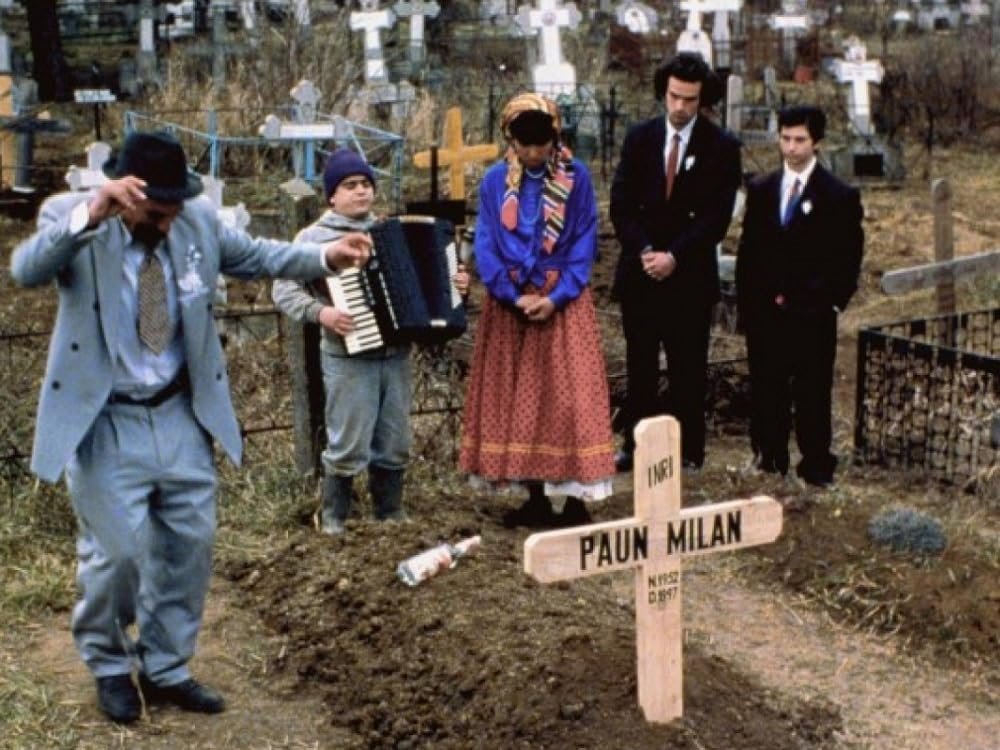
By the time the 102 minutes of that sacred timeline finished, the depiction I watched reminded me of a title Alejandro G. Iñárritu once used: “The Unexpected Virtue of Ignorance.” Because what I watched were real people who had found answers to my existential questions in the first place, despite facing huge difficulties differing from me, like not even having a country to live in easily. Whether they are intentionally aware of it or not, Gypsies are the brightest example showing that life will always be miserable; however, an outre wise factor—ignorance of that misery—is possible too…
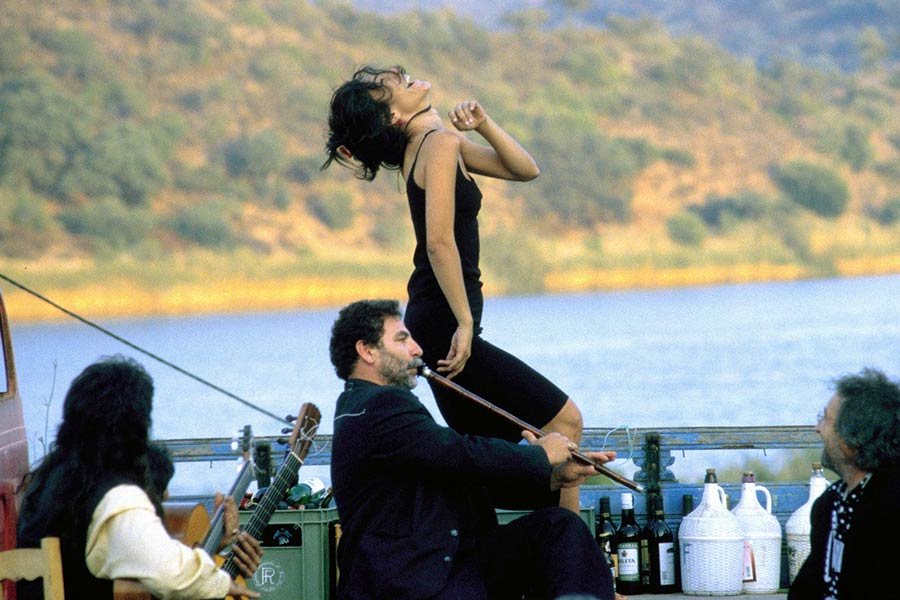
From my standpoint, the next step to understanding Tony Gatlif through his filmography should be jumping into his other film, Vengo (2000). The rationale behind my offering such a directly dictating opinion is that in Vengo, we also watch Mr. Gatlif’s endearing perspective that art always stands as a shelter from a devastating life. Clearly, from the first moment of the movie, whenever music plays, joy surrounds both the characters and us, the audience. There is no need to talk about how badly things go when music isn’t playing and movements are not made through dance and flamenco… Serving as the literary catalyst for the title of this article as well, “Finding Home Literally Under the Roof of Art” is no metaphor… Because the concept of “art always stands as a shelter apart from a devastating life” reflects reality in Tony Gatlif’s own life, where he saw people tortured and slaughtered in front of him at the age of 12 in his home country, and hid between theater rows at nights in France…
Finally, I want to mention the 700th film I watched yesterday… Actually, it turned out to be quite weird. ‘Cause there were almost no countable credited actors who had any dialogue, and not a single person I could identify as the protagonist. The film started in Rajasthan, Northern India, continued in Egypt, then jumped neatly to Istanbul, Türkiye in modern period, and wandering through the Balkans and France, it finished on a hillock in Andalusia, Spain… The result was that Furqan gave it 5 stars, more pleased than ever… Latcho Drom… Becoming completely certain of dear Tony Gatlif’s genius through such a documentary like miracle, I silently said REST IN PEACE to this lovely friend, and went on with my boring everyday life like a traveler… like everyone… like a Gypsy… not knowing whether I am truly free or not…

Dear Tony Gatlif… What I enjoy are emotions, setting out on a journey, and discoveries as well… Just to everyone…
Sincerely yours,
—Furqan


Leave a Reply